What Buyers Should Know About Coordinating quotes from multiple manufacturers
Managing several manufacturer quotations is a communication task as much as a spreadsheet task. Suppliers need the same current documents, a clear deadline, a reliable channel for questions, and a controlled way to return revisions. Buyers need to protect confidential information, avoid inconsistent interpretations, and leave enough time to resolve gaps before a sourcing decision.
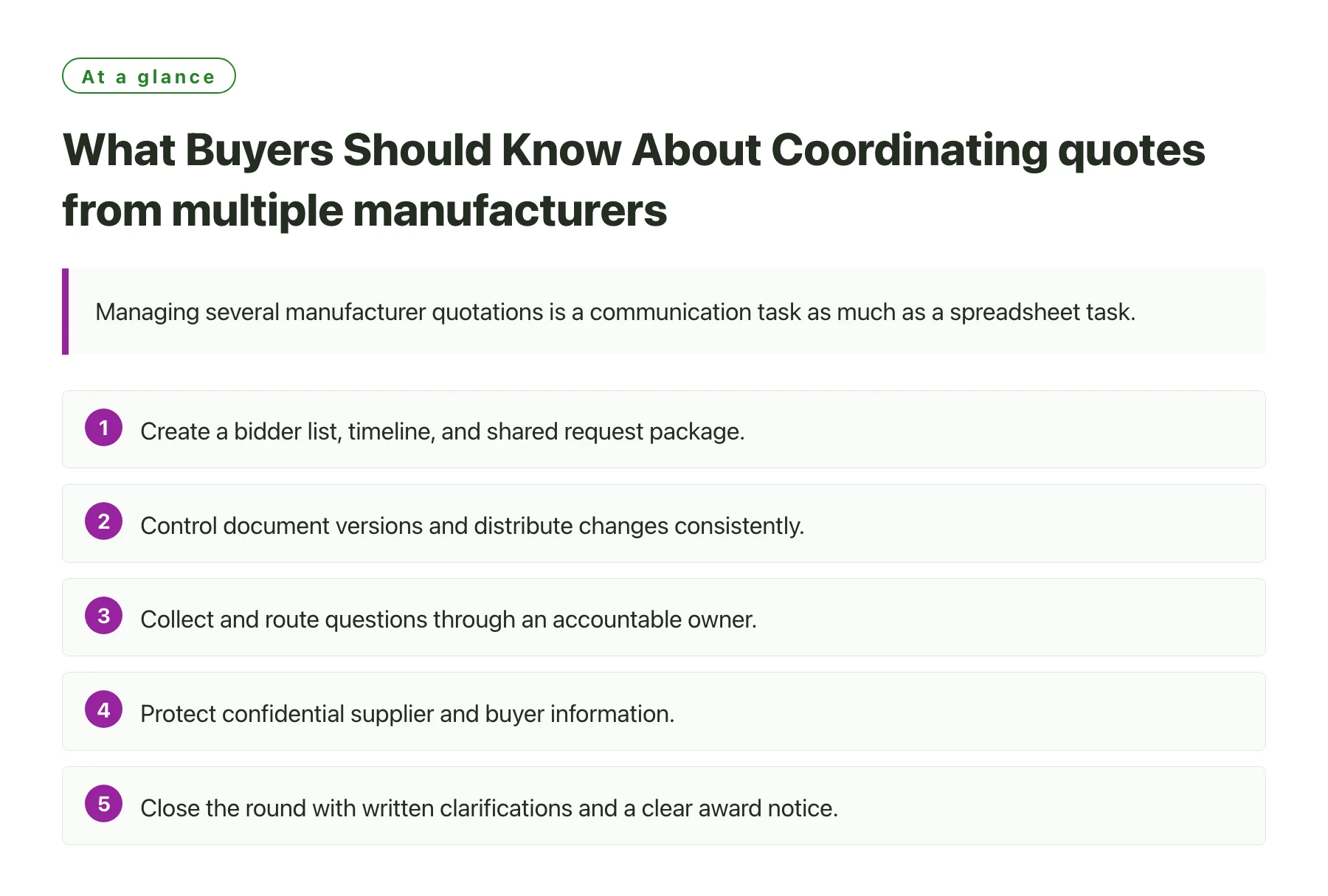
Key takeawaysCreate a bidder list, timeline, and shared request package. · Control document versions and distribute changes consistently. · Collect and route questions through an accountable owner. · Protect confidential supplier and buyer information. · Close the round with written clarifications and a clear award notice.
A well-managed quotation round gives each manufacturer a fair chance to respond while maintaining one authoritative record of instructions and decisions.
1. Set the purpose, bidder list, and decision calendar
Decide what the round should establish: price, capability, capacity, lead time, technical approach, or a combination. List invited manufacturers, primary contacts, language needs, and expected response format. Set milestones for acknowledgement, questions, clarifications, quote submission, review, and decision.
Allow enough time for technical questions and internal review. Identify the person who can extend the deadline or approve a late response. Give all bidders the same timeline where practical, and record any approved exception so the comparison remains fair and traceable.
2. Assemble and version the request package
Prepare the request letter, specification, drawings, quantity schedule, packaging requirements, quality plan, destination, commercial terms, and response template. Assign each file a revision and issue date. Define how suppliers should name and return files.
Maintain a master distribution log with supplier, recipient, document revision, issue time, acknowledgement, and replacement notice. If a specification changes, send a controlled revision to all affected bidders and state whether the submission deadline moves. Avoid relying on attachments buried in separate email threads.
3. Establish one channel for questions and answers
Name the buyer-side question owner and a backup. Ask suppliers to use a standard form that references document, section, issue, proposed interpretation, and due date. Route technical questions to engineering, quality questions to the quality owner, and commercial questions to procurement.
Decide which answers affect all bidders. Issue shared clarifications without disclosing a competitor’s identity or confidential commercial information. Record the question, approved answer, date issued, affected document, and recipients. A verbal explanation should be followed by a written record.
4. Protect confidentiality and fair treatment
Set expectations for confidential drawings, pricing, supplier methods, and customer data. Share only the information needed for the quotation and clarify permitted use and retention. Do not circulate one manufacturer’s price or proposal to another without authorization.
If bidders need different product or market information, document why and whether it changes scope. Apply common response rules, while recognizing that technical clarification may differ by supplier capability. Keep confidential notes restricted to the evaluation team and preserve the basis for any unequal treatment.
5. Track acknowledgement and completeness
Use a tracker for acknowledgement, missing files, unanswered questions, submitted quotation, validity, currency, commercial terms, exceptions, and revision number. Confirm that each quote covers the required product scope and identifies the supplier entity, production site, and contact.
Flag incomplete offers promptly and send a specific request for missing information with a consistent response deadline. Distinguish “not offered,” “not applicable,” and “not answered.” Do not treat an empty field as acceptance or silently fill it using another supplier’s assumptions.
6. Manage revisions without losing history
Require every revised offer to include a new revision identifier, date, and summary of changes. Preserve the original and intermediate versions. Update the comparison sheet from the current approved file, not from copied values in an old email.
For material changes to quantity, specification, delivery point, or timing, consider whether all bidders should receive the same updated request. If only one supplier is asked to revise, record the reason and assess whether the change affects fairness or comparability.
7. Keep the technical and commercial reviews aligned
Technical reviewers should identify compliance, exceptions, evidence gaps, and conditions without changing the supplier’s commercial numbers. Commercial reviewers should clarify price basis, quantity tiers, lead time, validity, payment, tooling, packaging, and delivery scope. Use a shared status for unresolved items.
When delivery terms or logistics affect the proposal, record the exact rule and named place, plus any services included or excluded. ICC Incoterms® rules allocate specified delivery tasks, costs, and risks when incorporated into a contract; the quote still needs clear operational details. [1]
8. Prepare a decision record and negotiate clearly
Summarize compliant offers, material gaps, assumptions, total-cost factors, capacity evidence, quality concerns, and open risks. Separate mandatory screening from weighted preferences. Identify which clarifications are confirmed and which remain estimates.
If negotiating with a preferred bidder, define who may negotiate and what approval limits apply. Keep concessions and revised terms in writing. Avoid implying an award before internal approval or revealing another bidder’s confidential proposal as a bargaining tactic.
9. Communicate the outcome and close the round
Send a written award or non-selection notice after the decision is approved. State the selected scope, next steps, document set, and contact for contract or sample work. Where appropriate, provide unsuccessful bidders with concise feedback without disclosing protected information.
Archive the request package, distribution and question logs, all offers, evaluations, approvals, and notices. Retain the records under the buyer’s policy so later disputes or repeat orders can be traced to the correct version.
10. Improve the next quotation cycle
After award, review response completeness, question themes, late submissions, version errors, and internal review time. Determine whether the request package was clear and whether any supplier interpreted key requirements differently. Update templates through controlled revision.
Buyers coordinating JS Sourcing can make the round easier to manage with one source of truth, clear communication owners, and documented decisions. A repeatable process reduces avoidable rework and helps teams compare supplier responses without losing the context behind them.
Sources
Frequently asked questions
Should every clarification be sent to every bidder?
Share answers that change common requirements while protecting supplier identity and confidential proposal details.
How should buyers handle a revised supplier quote?
Require a revision number, preserve earlier versions, and update the evaluation only from the current approved offer.
Can one bidder receive an extended deadline?
Document the reason, approval, scope, and effect on fairness; apply consistent treatment where feasible.
What should be kept after a quote round closes?
Retain request versions, distribution records, questions, responses, quotations, evaluations, approvals, and notices.