Watching an Hourly Payout Land in the Wallet
Most guides describe payouts as a rate; the wallet shows them as a series of arrivals. At 1 PH/s under PPS+, the credit is 0.00044861 BTC a day, or 0.00001869 BTC an hour, and thirty-six hours of continuous running leaves 0.00067291 BTC in the balance, worth $56.99 at BTC $84,692. Counting those arrivals is the simplest way to confirm that everything between the miner and the balance is working.

Key takeaways
- At 1 PH/s the hourly credit is 0.00001869 BTC, which is $1.58 at BTC $84,692.
- Six hours should produce 0.00011215 BTC and thirty-six hours 0.00067291 BTC, if uptime is continuous.
- Payouts into the mining balance carry no fee, so the credited amount is the amount you keep.
- A missing hour is easier to spot in a deposit history than in a monthly total.
Where the coins actually arrive
A mining credit does not appear in your private wallet automatically. It lands in ViaBTC Crypto Wallet, the multi-currency balance tied to the same login as the mining dashboard. From there you decide whether to withdraw, convert or leave it. That distinction matters when a miner reports "the payout did not arrive" while looking at a hardware wallet that was never the destination.
The internal balance is also where the fee schedule is easiest to observe. The credit is already net of the listed rate, so the number that appears is the number you keep until you choose to move it. Withdrawals of mining proceeds carry no fee, which means there is no threshold to reach before taking coins out.
The 36-hour staircase at 1 PH/s
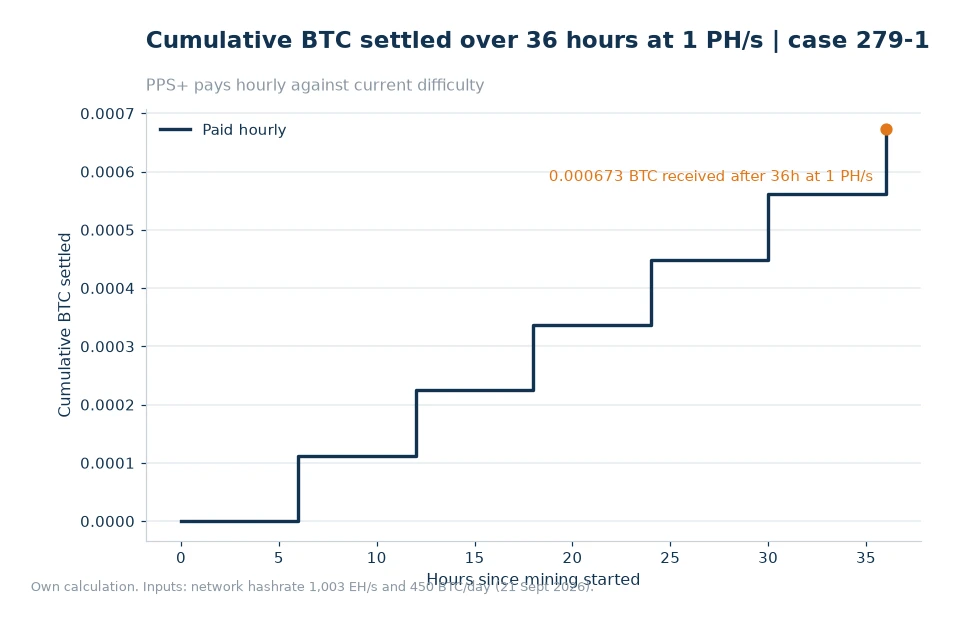
Pick a start time and write down the balance. Every six hours, write it down again. The sequence should look like a staircase with equal steps: 0.00011215, 0.00022430, 0.00033645, 0.00044861, 0.00056076, 0.00067291. If a step is missing, an hour was missed; if a step is half size, part of the hashrate was offline.
This is a better test than comparing daily totals, because a day is long enough for two errors to cancel out. A machine that was down for two hours in the morning and a settlement that arrived late in the evening can produce a daily figure that looks correct while the underlying series is wrong.
| Hour | BTC settled | USD at $84,692 | Share of 36-hour total |
|---|---|---|---|
| 6 | 0.00011215 | $9.50 | 16.7% |
| 12 | 0.00022430 | $19.00 | 33.3% |
| 30 | 0.00056076 | $47.49 | 83.3% |
| 36 | 0.00067291 | $56.99 | 100% |
The share column is the one to use when the total is off. If the 36-hour figure is 94% of the model, the shortfall is about two hours of uptime, and the deposit history will show which hours are missing. If it is 50%, the machine was running half the time or only half the workers were connected.
Reading the deposit history properly
Each settlement line should carry a timestamp, an amount and a status. Sort by time rather than by amount. A line that is pending is not a line that is missing, and the two look identical if you only check the balance at the top of the screen. Sort ascending and look for gaps longer than an hour.
Compare the timestamps with your own maintenance log. A reboot at 14:20 explains a smaller credit at 15:00 and nothing else. Without the log, the same credit looks like a pool error. The two records together answer most questions without opening a support ticket, and they take about a minute a day to keep.
Note the difference between a settlement and a transfer. The staircase counts settlements into the mining balance; a withdrawal is a separate event with its own timestamp and, on some networks, its own confirmation wait. Mixing the two in one list is how a miner concludes that an hourly payout was late when the hourly payout was fine and only the withdrawal sat in a queue.
Wallet, exchange or hardware device
The internal balance is convenient for accumulating and for paying for services, but it is not a long-term store. Once the amount is meaningful, withdrawing to an address you control reduces the number of parties involved. The trade-off is a network fee and a confirmation wait, which is why small balances often stay put until they are worth moving.
An exchange address is the least private option and adds a counterparty, though it is the fastest route to a sale. A hardware wallet is the opposite: slower to spend, much harder to lose. Most miners end up with a split, holding a working balance in the pool account and the bulk of the savings outside it.
Whichever destination you choose, write it down before the first withdrawal and verify the first characters and the last four when pasting. A misdirected transfer on a settled chain cannot be reversed by anyone, and the pool cannot recall coins it has already sent. Test with a small amount if the address is new, then send the rest once it confirms.
Using the balance without withdrawing it
The account can hold more than one coin, and the multi-currency wallet lets you keep balances in several at once. That is useful for a miner who earns BTC but pays some costs in another asset, or who wants to hold a mix without running separate wallets. Auto Conversion moves between coins inside the account when you decide the ratio is right.
There is also a lending route for miners who need liquidity without selling: Collateral-Pledged Loans use held coins as security through a sequence of Add Collateral, Apply for Loan, Receive Loan, Repay Loan and Redeem Collateral. It is a borrowing product, so the collateral is committed until the loan is repaid, and the balance shown as available is not the same as the balance shown as total.
The first withdrawal is a test
Send a small amount first, confirm it arrives at the address you intended, then send the rest. The test costs one network fee and catches the two mistakes that matter: an address copied from the wrong place and a chain selected by habit. Neither is recoverable once the coins are on their way.
Keep the confirmed address in the wallet's book so the next withdrawal does not repeat the exercise. A saved address that has been used once is more reliable than a fresh copy, and the book also makes it obvious when a withdrawal is going somewhere new.
Worked example
Follow the 36-hour staircase from the network total to the dollar figure in the last row of the table.
- A terahash is worth 0.00000044865 BTC a day when 450 BTC is divided by 1.003 billion TH/s.
- 1 PH/s is 1,000 TH/s: 1,000 × 0.00000044865 = 0.00044861 BTC a day.
- Hourly: 0.00044861 ÷ 24 = 0.00001869 BTC, or $1.58 at $84,692.
- Six hours: 6 × 0.00001869 = 0.00011215 BTC, and 0.00011215 × 84,692 = $9.50.
- Twelve hours: 0.00022430 BTC, or $19.00; thirty hours: 0.00056076 BTC, or $47.49.
- Thirty-six hours: 0.00067291 BTC, or $56.99. Two hours of downtime inside the window would remove 0.00003738 BTC, about $3.17.
Frequently asked questions
How often does the wallet receive a mining credit?
Under PPS+ the block-reward component settles hourly against current difficulty, so a steady 1 PH/s produces about 0.00001869 BTC an hour.
Is there a fee to withdraw mining proceeds?
Mining payouts are zero-fee, so the credited amount is what you keep; a network fee can still apply when coins leave for an external address.
Why is my balance lower than the sum of the deposit lines?
Part of the balance may be committed as loan collateral or held in another currency after a conversion, so check the total and available figures separately.
Check the arrivals, not the headline balance
A balance is a single number that hides its own history. The deposit list is where the evidence lives, and a weekly glance at it catches the failures that a monthly total absorbs. Set a reminder for the same hour each week, note the amount and the count of settlements, and compare with the model.
Open the wallet from the same account you mine with, and keep the withdrawal address book tidy so a transfer does not go to an old address. The fee schedule explains what has already been deducted before the credit appears, and the Profit Calculator gives the expected daily figure if you want a second opinion on the model.
Sources: ViaBTC wallet and fee documentation[1]. The 21 Sept 2026 inputs were 1,003 EH/s of network hashrate, 132.76 T difficulty, 3.125 BTC per block, 144 blocks a day, BTC $84,692. Published 24 Oct 2026; the staircase assumes constant uptime and difficulty.