Skin or Blotter: How to Test a Fragrance Sample Properly
A paper blotter and a wrist answer two different questions. The blotter shows how a formula is built, how the materials sit together and how quickly the top notes lift off; skin shows how the scent behaves over hours in contact with a body. Most sampling mistakes come from using one method to answer the other's question, and the fix is a short protocol rather than better noses.
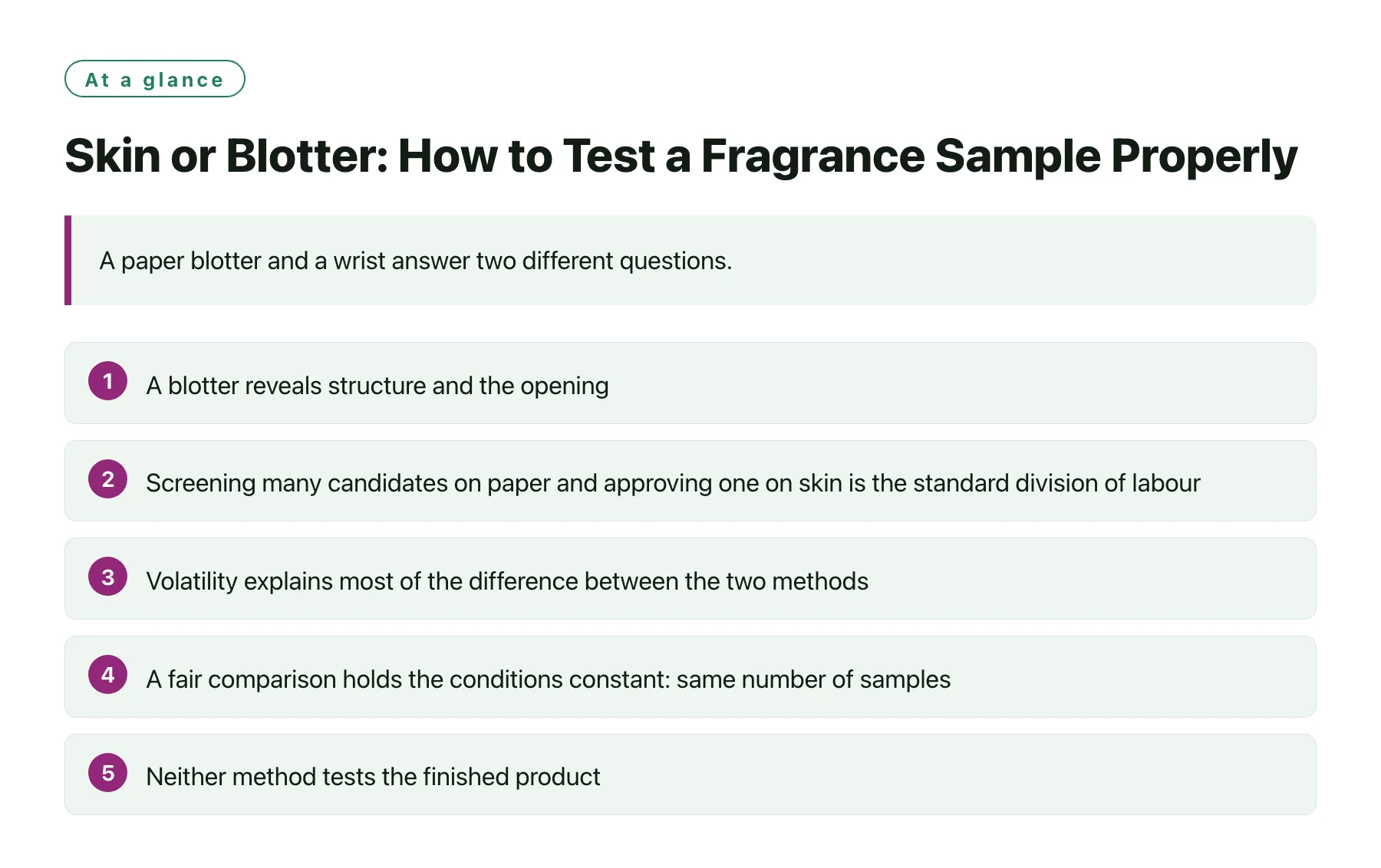
Key takeaways
- A blotter reveals structure and the opening, while skin reveals how a scent evolves and how long it stays perceptible.
- Screening many candidates on paper and approving one on skin is the standard division of labour, and reversing it wastes time.
- Volatility explains most of the difference between the two methods, because the materials that leave paper fastest also leave skin fastest.
- A fair comparison holds the conditions constant: same number of samples, same timing, no competing scents, and more than one wearer.
- Neither method tests the finished product, so a candidate should also be evaluated in the carrier and format it will ship in.
Sampling sessions tend to be informal: a row of blotters, a few opinions, a decision. That is enough to sort candidates into plausible and not plausible, and it is not enough to approve a formula.
Understanding what each method can and cannot show makes the whole process faster, because it tells you which question belongs to which test.
What each method reveals and hides
| Method | What it reveals | What it hides | Best used for |
|---|---|---|---|
| Paper blotter | Opening, structure and the balance between materials | Skin chemistry, warmth and behaviour over several hours | Screening many candidates quickly |
| Skin, first minutes | How the opening reads once it meets skin | The dry-down and how the scent evolves | Judging the immediate impression |
| Skin, several hours later | The dry-down and how long the scent remains perceptible | The opening, which has already gone | Deciding on a final candidate |
| Fabric or clothing | How the scent behaves on textile and how long it lingers there | Skin interaction entirely | Home and body products, and scent on garments |
| A second wearer | How much of the impression depends on individual skin | Nothing; it adds an independent data point | Confirming a candidate before approval |
The table is not a ranking. It is a division of labour: paper narrows the field, skin decides the winner, and a second wearer tells you whether the winner is robust or accidental.
Two methods, two different questions
The difference between a blotter and skin is not simply strength; it is what happens to the materials over time and what else is present when they evaporate.
The blotter gives an engineering view
Fragrance composition is commonly described through top, heart and base notes, a convention summarised in general reference works on perfume [1]. A blotter makes that structure visible: the opening arrives, the heart shows itself, and the base settles in a fairly predictable sequence without interference.
That predictability is exactly why blotters are useful for comparison. Two candidates can be judged side by side on the same substrate, and differences in construction are easier to attribute to the formula rather than to the person wearing it.
Skin adds chemistry and time
On skin, the same materials meet warmth, moisture and the surface chemistry of an individual body. Volatility still drives the sequence, which is why the materials that disappear from paper first also tend to disappear from skin first; chemistry explains much of the rest of the variation between wearers.
How molecular behaviour shapes what a nose detects is a subject covered in chemistry writing and education [2], and it is where the practical rules of thumb come from. The American Chemical Society publishes educational and research material on chemistry, including work on how structure relates to odour perception [3]. The takeaway for a sampling session is simple: perception depends on both the molecule and the environment it evaporates into.
Neither method tests the finished product
A concentrate on paper is not a body lotion, and neither is an alcohol spray. Once the direction is chosen, the candidate should be evaluated in the carrier and format it will ship in, because the base changes how the scent lifts and how it feels.
Running a comparison that means something
- Limit the sessionEvaluate no more than a handful of candidates at a time, because the nose fatigues and everything starts to smell similar.
- Label everything before you startCodes on blotters and vials, written down in order, so an impression can be traced back to a formula later.
- Use the same amount on each wearerOne spray or one dab per site, applied to the same place, so differences come from the formula rather than the dose.
- Record two moments, not oneNote the impression just after application and again several hours later, when the dry-down is what remains.
- Repeat on a second personIf a candidate only works on one wearer, that is useful information rather than a nuisance.
- Smell something neutral between samplesCoffee beans are a habit rather than a fix, but a short break away from the samples does reduce carry-over.
Mistakes that distort the result
Sampling errors are usually procedural rather than sensory. A few habits cause most of the confusion.
Testing in the wrong order
Judging a delicate candidate immediately after a heavy one almost guarantees a poor verdict. Move from lighter to heavier, or take a proper break between the two.
Trusting memory across days
Impressions recorded a week apart are not comparable unless a reference sample is kept and revisited. Keep an approved reference sealed and dated, so the comparison is against a known quantity.
It is also reasonable to ask a supplier such as Guangzhou Xuelei to include both blotters and filled vials in a sampling shipment, because the two formats answer different questions and a brand usually needs both before it can approve a formula.
Approving on paper alone
A candidate that behaves well on paper can lose its structure on skin within an hour. For any formula that matters commercially, the approval decision belongs on skin, at more than one time point, on more than one person.
If a sampling session has to be shortened, shorten the screening rather than the wear testing. Paper comparisons can be run quickly and in large numbers, while skin testing cannot be compressed without losing the information that matters most. Write down what each candidate is supposed to prove before the session starts, keep the conditions the same for every sample, and record the dry-down even when the opening was disappointing. The notes from a disciplined session are worth more than a shelf of samples, because they explain the decision to whoever inherits the project next.
Sources
- Wikipedia: Perfume —— An encyclopaedic overview of perfume covering definitions, history, the note structure of a fragrance and concentration terminology (background reference only).
- Chemistry World (Royal Society of Chemistry) —— The Royal Society of Chemistry's magazine, covering chemistry research and explanations of everyday materials including aroma compounds.
- American Chemical Society —— A scientific society publishing chemistry research and educational resources, including material on aroma and volatile compounds.
Frequently asked questions
Should I test perfume on a blotter or on skin?
Both, in that order. Use blotters to screen candidates and compare how they are built, then move the shortlist to skin to see how each one evolves over hours. The blotter is faster and more comparable; skin is slower and closer to what a customer will actually experience.
Why does a perfume smell different on me than on paper?
Skin adds warmth, moisture and surface chemistry to the evaporation process, so some materials lift faster and others are held back. The sequence of notes stays broadly similar, but the balance and the duration change. That is normal and is one reason a formula should be tested on more than one person.
How many fragrances can I evaluate in one session?
Fewer than most people attempt. Nose fatigue sets in quickly, and after a handful of samples the impressions start to merge. A short session with well-labelled samples and a recorded dry-down produces more usable information than a long session with a dozen blotters.
How long should I wait before judging a fragrance?
Judge it at more than one point rather than at a single moment. The opening is informative and short; the dry-down is what most customers will live with. Recording an impression shortly after application and again several hours later gives a far better picture than a single snapshot.
Does testing on a blotter predict how a finished product will perform?
Only partly. A blotter shows the formula's structure and its top notes, but it cannot show how the scent behaves in a lotion, a shampoo base or an alcohol carrier, nor how it interacts with the packaging. Test the final format before approval and keep a reference sample for later comparison.